
Understanding Trinities: Part 1 – Spiritual & Metaphysical Trinities
BOOK III: The Enigmatic Mystery (Science & Religion) – Consideration #214


Be A Part of the Conversation!
Tuesday November 11, 2025
“He who denies the Trinity loses his soul;
he who tries to explain the Trinity loses his mind.”– Tertullian
PREFACE
Welcome Everybody!
This week we begin an overview regarding one of the key considerations of the book series: a new paradigm-shift into what I refer to as “quantum consciousness,” or a new kind of “quantum trinity,” currently being manifested as Artificial Intelligence.
In this consideration, we are essentially considering a shift in focus from an objective empirical reality based on a foundation of dualism, to a new rational “quantum” understanding of How Things Work, which at first glance appears to contradict our past understanding of reality. Understanding this unique quantum mechanism of reality could become the third “rational” factor that, when added to the apparent “opposites” of empirical and rational dualism, is “synthesized” into a new quantum understanding of how the universe, or reality, “really works” in terms of its “totality.”
“this is not some kind of new-age ‘mumbo-jumbo…’”
If you have read the book-series, or have been consistently reading the weekly Substack, you recognize that this is not some kind of new-age “mumbo-jumbo” trying to establish a new “vision” of reality. It is a natural consideration based on the previous causal links in a long chain leading to our current perception of reality. The essence of this consideration is about how human beings have attempted to transcend the limitation of dualism through rational metaphors based on trinities. These trinities become the foundation for complex rational thoughts and ideas supporting the concepts responsible for virtually all critical paradigm shifts throughout human history.
“Could this new third ‘quantum factor’ expand our understanding of reality?”
It is important to remember that the considerations reflected in the books and Substack posts are not intended to be thought of as “new axioms” of reality designed to shatter your current beliefs about reality; simply something to think about in connection to your current perception of reality. These considerations are not meant to question the validity or truth of either the empirical reality of science, or the rational reality of Spirit, but to see how they may be connected in terms of our new understanding of quantum reality.
Could this new third “quantum factor” expand our understanding of reality in a way that ends the schism between science and religion? Might it provide new insights into how our rational and empirical reality may “fit together” with “quantum reality” to manifest our perception and understanding of the universe?
“…how do we keep this new paradigm shift from replacing our ‘human perception’ of reality?”
For centuries, Western culture has sought to transcend empirical duality through empirical scientific investigation as well as rational spiritual investigation. What if the third factor related to synthesizing this apparent duality was directly related to our discovery of “quantum reality” and our development of “Artificial Intelligence” and “Quantum Computing?”
How might this new paradigm shift be incorporated into our various current individual and social belief systems in a way that does not destroy them but might actually reveal even greater “truths” connected to them? Another critical consideration related to this is, how do we keep this new paradigm shift from replacing our “human perception” of reality?
These considerations embrace both the empirical scientific and the rational spiritual understanding of reality; because they are the belief systems that connect us to this new paradigm shift. So the question becomes, can we incorporate a new quantum reality into our current understanding of reality, or will this new quantum reality replace human reality?
CONSIDERATION #214 – Spiritual & Philosophical Trinities
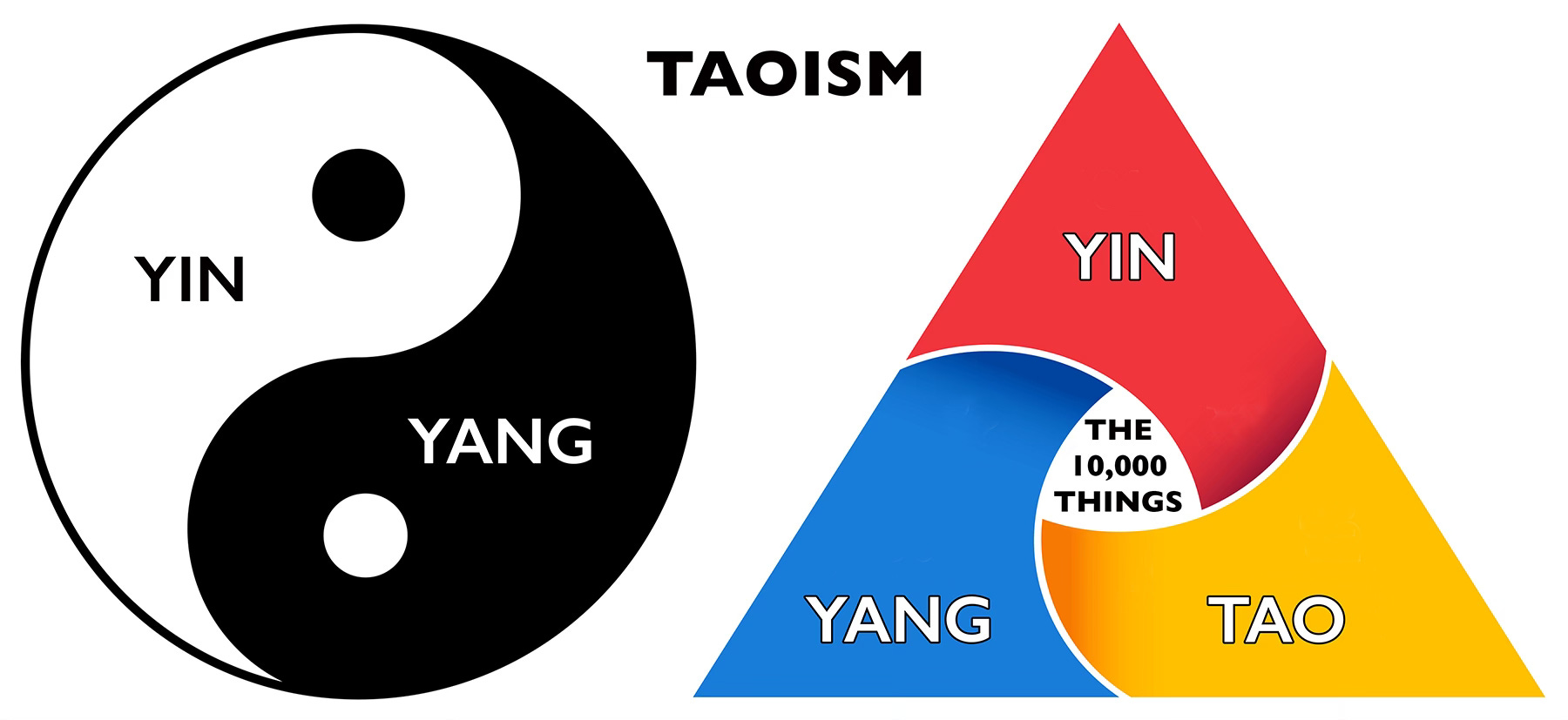
Taoism represents a very simple example of how dualities can become trinities. The duality of empirical reality is represented by two opposite forces: yin and yang. Yin reflects a passive, receptive, factor associated with feminine qualities and negatively charged energy. Yang reflects an active, dynamic, factor associated with masculine qualities and positively charged energy. Negative and Positive energies are not associated with “good” or “bad” qualities, but simply represent two opposite forms of energy that interact with each other in specific ways.
“To move beyond this incongruent duality requires a third factor…”
The physical, or empirical, world of reality appears as opposites; it is expressed through duality. However, to move beyond this incongruent duality requires a third factor that synthesizes the apparent duality into a more powerful unity of thought. Lao Tzu called this third factor of reality, Tao. In Taoism, the Tao is an undefined factor of reality that generates and unifies the forces of yin and yang. Lao Tzu purposely leaves this third factor undefined, because attempting to define it only brings more problems. He acknowledges it, but makes no attempt to identify or define it into a concept such as “God.”
“We learn about the nature of Tao by understanding the natural manifestations of yin and yang…”
Taoism defines empirical and rational morality in terms of how it appears naturally in empirical reality, as opposed to specific rules that were implemented by a rational “divine being.” We learn about the nature of Tao by understanding the natural manifestations of yin and yang in the world and in our lives. Taoism is essentially concerned with understanding “the process” as opposed to manipulating the process; it reflects a passive philosophy of “non-action” and “non-doing.” To become “one” with the nature of yin and yang is to become “one” with the Tao.
“They achieve harmony by combining these forces.”
According to Lao Tzu in Chapter #42 of the Tao Te Ching: “The Tao begot One.” (Unity) “One begot two.” (Dualism) “Two begot three.” (The mechanism for manifesting empirical reality) “And three begot the ten thousand things.” (The entire world, or universe) “The ten thousand things carry yin and embrace yang. They achieve harmony by combining these forces.” The opposites of yin and yang work “together” with Tao to produce physical reality.
“This rational or spiritual element synthesizes the two seemingly incongruent patterns…”
Although empirical reality is manifested through what appears to be two opposite forces of nature, adding a third rational or spiritual element connects and synthesizes the seemingly incongruent factors into a more complete understanding of the physical and rational aspects of reality. It is this “rational undefined force” (Tao) that somehow manifests reality through two seemingly incongruent forces called yin (-) and yang (+); synthesizing the two seemingly incongruent patterns of empirical reality (yang) and rational reality (yin) into a larger unified consideration of how things work.
Dualism reveals truth related to “what” is happening; Trinities reveal truth pertaining to “how” it happens; Unity reveals truth through a direct experience of “why” it is happening. The empirical, rational, and spiritual patterns of reality.
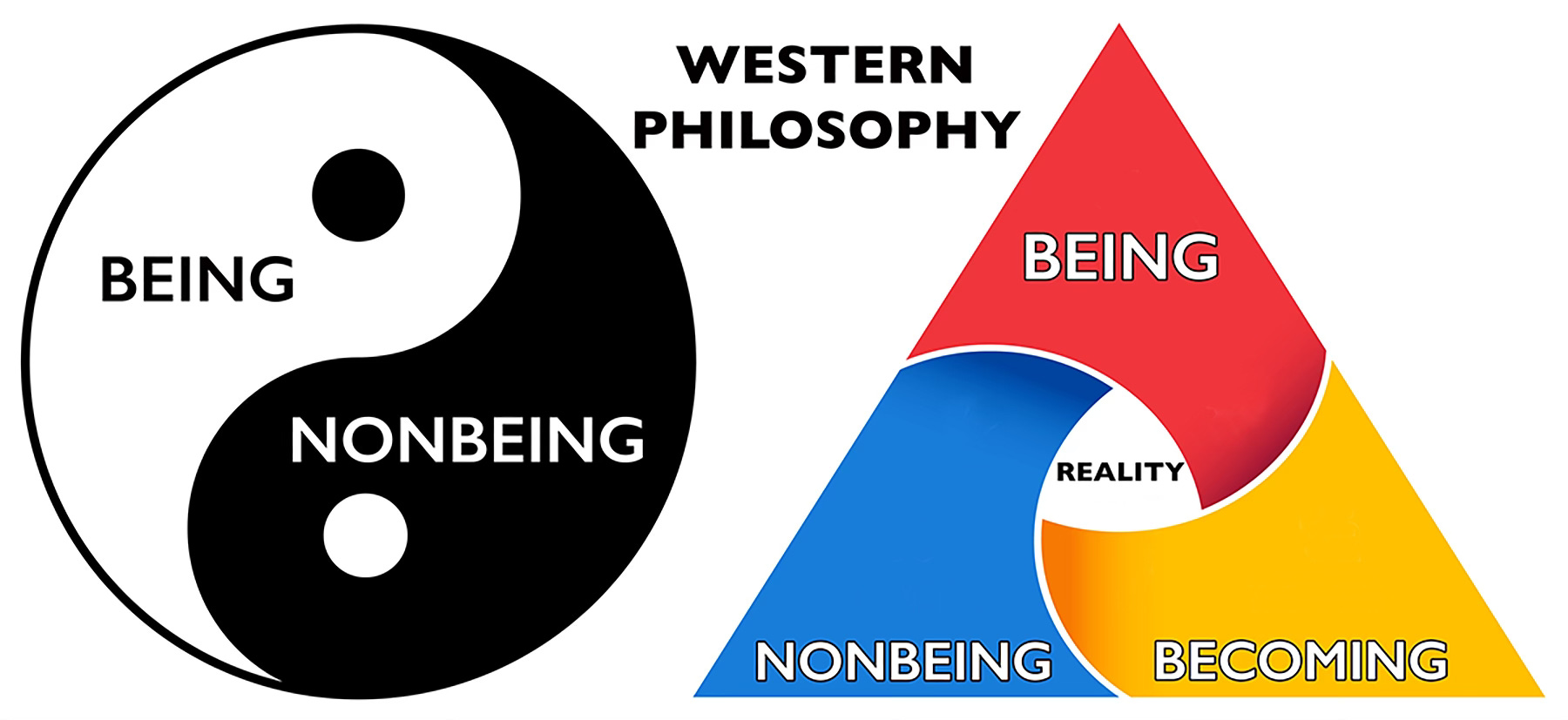
Western duality has traditionally been defined in terms of “being” and “nonbeing.” Hegel attempts to break this duality with a third factor he called “becoming” which “synthesizes” the incongruity between being and nonbeing. However, this does not completely resolve the issues related to “being” and “nonbeing.” Although problematic, Hegel’s theory of Absolute Truth opens the door for rational scientific theories such as Special and General Relativity and Quantum Mechanics.
“Hegel’s concept of ‘becoming’ is similar to Lao Tzu’s concept of ‘Tao’…”
Like Taoism, traditional ancient Western philosophy does not focus on defining the “source” of reality as much as on understanding the “process” of reality. Also like Taoism, Hegel’s concept of “becoming” is similar to Lao Tzu’s concept of “Tao,” in that both reflect a mechanism responsible for a process that manifests the “becoming” of the “10,000 things,” which in Taoism represents the entire world. Ironically, the rationalism of Western philosophy also makes ignoring the “first cause” of reality impossible.
The Judeo-Christian Tradition is unique from Taoism and traditional Western philosophy because it attempts to directly apply and implement rational spiritual concepts into the empirical world in a way that alters the reality of the empirical world. Unlike Taoism, the Judeo-Christian tradition is about taking actions in the physical world of empirical reality that will alter and “improve” our experience of empirical reality. The mechanism for this transition is rational morality, which involves a spiritual understanding of reality.
“The world of human beings is experienced as a duality of choices…”
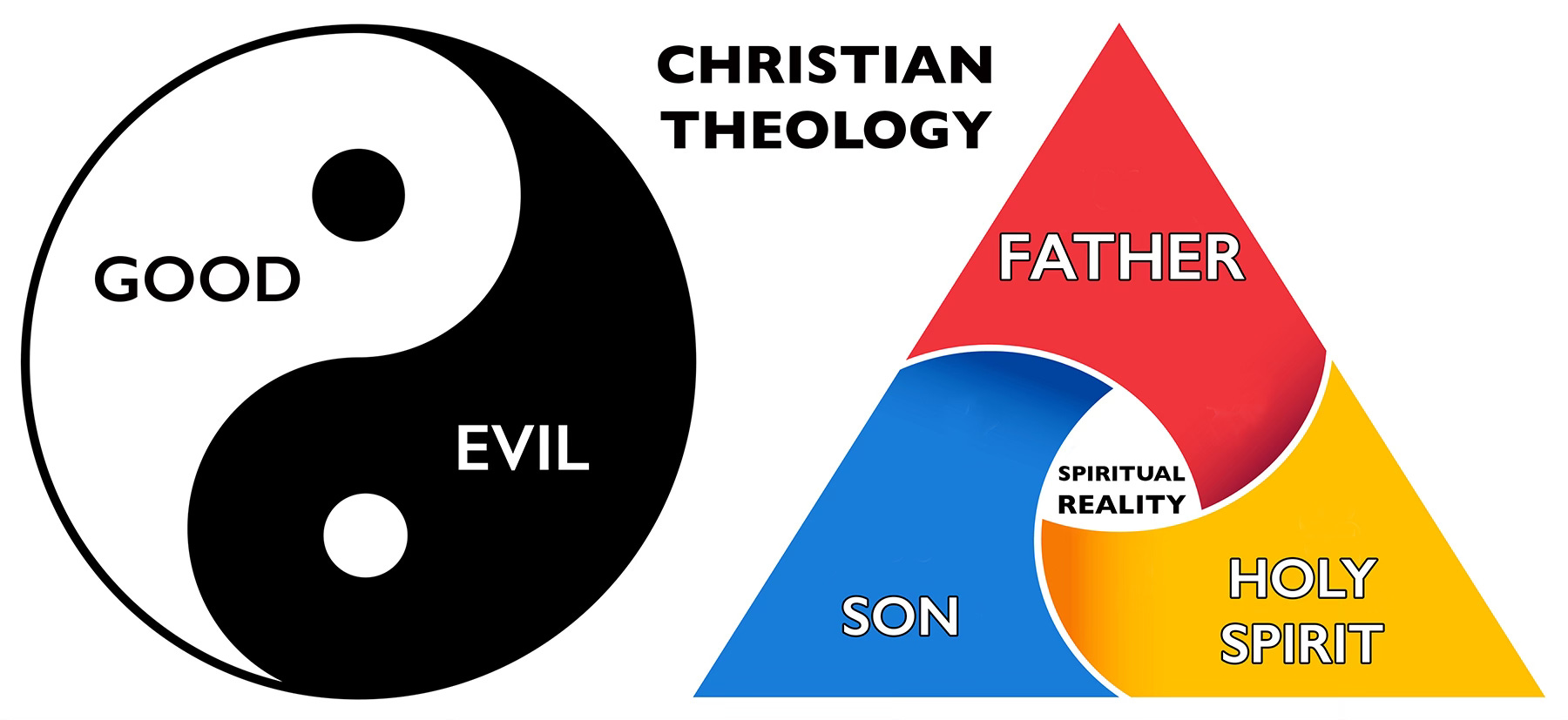
In this tradition, there is a rational “first cause” for reality called “God.” This “divine rational consciousness” or “Being,” along with two other factors called “the Son” and the Holy Spirit,” brings the empirical world we call the universe into existence. However, human beings lose their connection to this divine experience of reality and become trapped in a world of dualism and a constant choice between good and evil. God develops a plan making it possible for human beings to escape a reality of dualism through a Unity of “Oneness” with the Spirit of God.
The world of human beings is experienced as a duality of choices involving good and evil which directly affects how human beings experience their reality. However, there is a larger “spiritual reality” which has the power to transcend the limited experience of empirical reality. The limited duality of mankind (good and evil) can only be transcended by understanding and experiencing a higher rationality called God; a trinity that surpasses and overcomes the limited duality of good and evil.
“Christianity attempts to implement this change through a new Rational Morality…”
Understanding the limitations connected to the dualism of good and evil requires an understanding of how good and evil work in establishing the reality of human beings, and how that reality can be changed. The Judeo-Christian tradition is about actively taking empirical and rational responsibility for individual and social choices in terms of “good and evil” by actively and purposefully implementing a new moral reality by changing our individual thoughts and actions.
Judaism attempts to make this change through the implementation of Empirical Law designed to rationally govern and manage human behavior and interaction with each other. Christianity attempts to implement this change through a Rational Morality based on love, faith, and redemption.
“We are directly responsible for the future we create...”
Both of these traditions are founded on a faith that human beings, and human consciousness, have a direct effect on empirical reality. Therefore, we are directly responsible for the future we create. Ultimately, it is a spiritual training manual for transforming empirical reality into The Kingdom of Heaven. It connects the possibility and potentiality of the Father, with the physicality and empirical reality of the Son, unified through a rational unifying spiritual factor called the Holy Spirit.
In this trinity the duality of good and evil is transformed into a spiritual understanding and experience of God; which is expressed through the Holy Trinity.
POSTSCRIPT
In Taoism the empirical reality of opposites is an illusion, therefore it is not something that needs to be changed; it is something that needs to be recognized. Recognizing and understanding the empirical patterns of nature (yin and yang) and its connection to the source of all things (Tao) lifts the veil of this illusion.
Attempting to engage or interfere with this illusion, only expands the illusion. Therefore, it is better to acknowledge the illusion and experience the truth of Unity, which exists beyond the limitations of duality. In Taoism and Buddhism this is accomplished through meditation and repudiation of the false reality.
“Reality was not considered to be an illusion, but rather a self-evident truth.”
In Western philosophy and metaphysics, reality has traditionally been a duality consisting of “being” and “nonbeing.” Empirical reality was not considered to be an illusion, but rather a self-evident truth. Hegel attempts to break this duality by adding a third factor he called “becoming,” or “being in time.” Although it does not fully resolve the issues related to being and nonbeing, it does set a philosophical foundation for the possibility of more rational scientific considerations such as Relativity Theory and Quantum Mechanics.
“Unlike Taoism, the Judeo-Christian Tradition reflects a philosophy of empirical action and responsibility…”
Judeo-Christian tradition attempts to fill in the missing piece of Western philosophy with a spiritual consideration of reality in which a rational “unified being” called God is the “first cause” of essentially “everything.” God’s “being” is eternal, and we, like everything else in the universe, are part of that eternal being. Thus eliminating the problem of “non-being” faced by traditional Western philosophy.
In addition, unlike Taoism, the Judeo-Christian tradition reflects a philosophy of empirical action and responsibility in terms of actively engaging with the physical world in an attempt to improve it. With the help of God, human beings can, and should, attempt to make the world a better place. This occurs through understanding and embracing rational, or spiritual, thinking and behavior.
“Trinities are a way of structuring the incongruent patterns of empirical reality into a new rational model of understanding…”
Spiritual, metaphysical, and philosophical trinities reflect how various thought systems have dealt with the problem of duality. Trinities are a way of structuring the incongruent patterns of empirical reality into a new rational model of understanding that makes both empirical and rational paradoxes comprehendible to human reason. They reflect the quintessence of pure rational thought pertaining to any specific idea or concept.
Next week we will consider the nature of rational scientific trinities…
Get More Reality with the “Reality by a Thread” Paid Upgrade!
Click Image to Learn More…

Unique Content Makes Untangling the Knots of Reality “One of the Best Podcasts about History!”
“…this unique Substack podcast by FRANK ELKINS is not strictly speaking history. It is a strange mix of history, philosophy, theology, spirituality, physics, and astronomy…Try this podcast for a start.”
– Barbora Jirincova, The Best Podcasts About History
Excerpt from this week’s Podcast: “Untangling The Good Samaritan & The Prodigal Son”
Excerpt from this week’s “Reality by a Thread” (Quantum Responsibility)
“If we think of Empiricism in relationship to Orthodox or Conservative principles we see a direct connection to balance. This is reflected through values such as “law and order.” If we think of Rationalism in relationship to Liberal or Avant-garde principles we see a direct connection to synthesis. What is the next step ‘beyond’ law and order? Just as the mass of an object increases as it reaches the speed of light, balance within a duality becomes more volatile as it reaches the point of synthesis.”
– Frank Elkins (Reality by a Thread: November 13, 2025)
All for less than a couple of cafe lattes every month at a local coffee shop! And You Will Have Something Interesting to Talk About With Your Friends at the Coffee Shop!!
Only $7.00 a month or $70.00 a year! UPGRADE NOW!


Click Image To Learn More!
Thanks Frank for another enlightening reply. I gleaned 3 main points: 1. The govt can’t legislate morality, 2. You can lead a horse to water, but…, etc., 3. Marx mark on economics doesn’t fly.
Eureka! Jesus was right again: “Love thy neighbor as yourself” to attain Ultimate Truth.
Does Zen satori require the same thing that Christianity does to achieve Nirvana?
Again, thanks for verifying Christianity via Western philosophy to this humble sinner.
I attempted to explain your Trinity, Dualism, AI to my friend and got this “Say What?” look so I forwarded your text.
To wit: “Like “faith” you cannot mandate a recognition or acceptance of Absolute Truth until someone is ready to accept it.” - Frank Elkins
P.S. for everyone on earth to achieve Christlike perfection, i.e.., Truth, heaven on an earth, is a tall order. I don’t foresee this happening in the near future. Perhaps AI can give us a boost.
Abstract ideas and concepts articulately theorized, Frank. (a 60s hippy might say “Heavy stuff, man, but like, it’s cool). I was introduced to German philosopher Georg Hegel in my senior year of high school when Mr Millikan explained how Karl Marx conceived his economic theory in “The Communist Manifesto.” Marx utilized Hegel’s duality of thesis and antithesis to be factored into synthesis. Hegel proposed capitalists (thesis) vs. workers (antithesis) to be synthesized to “form a more perfect union” (where’d we hear that phrase?!) as Communism. This ideology looks like a perfect solution to the inequality status of capitalists vs workers… at least it does on paper. The issue Marx and his comrade, Friedrich Engels, failed to fully understand was human nature and economics.